Call most IT companies and you get hold music, then a ticket number. Call us and a technician says hello.
The short answer: an IT provider who answers the phone
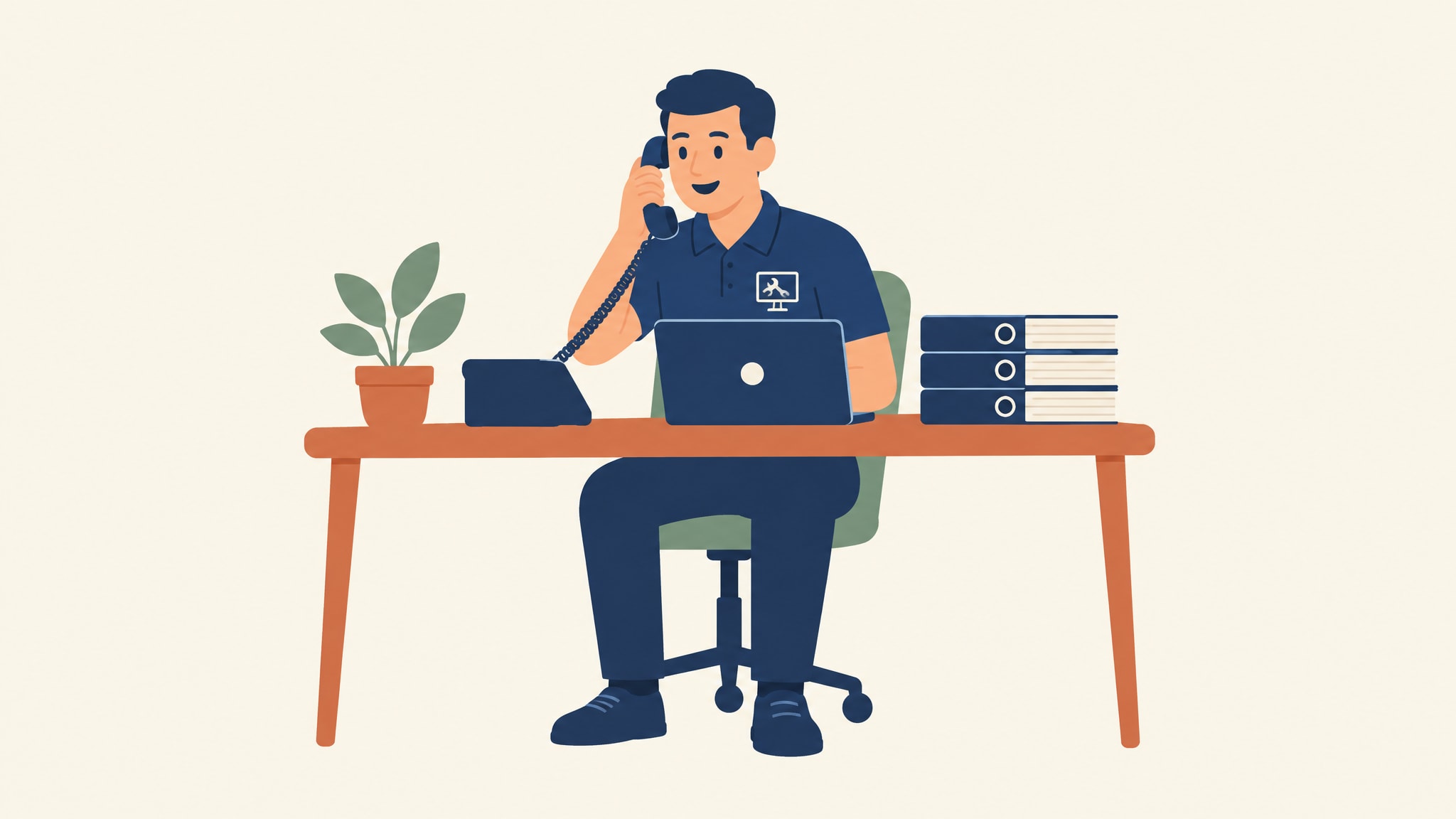
When you call 404 Network Ninjas, a technician from our small team picks up. Not a ticket queue. Not an overseas desk working from a script. A person who can start on your problem while you’re still on the line.
We know how that sounds, because every provider on the internet claims to be a “trusted digital transformation partner.” We’re a family-run shop that has kept Metro Atlanta offices running for thirty years, and our pitch is shorter than that phrase: pick up the phone, know the client, fix the thing.
The rest of this page covers what that changes, why it matters more for clinics, law firms and churches, and how you can test any provider’s phone claim before you sign. That includes ours.
What ticket queues and overseas call centers do to a bad day
A bad IT day is already stressful. Your front desk can’t pull up the schedule, or the attorneys can’t open the document server, and every minute has a cost. The support model you’ve bought decides whether that day lasts one hour or four.
The ticket queue: a confirmation number and nobody’s name
You call, and the hold music starts. Eventually you reach a voicemail or a web form. Then an auto-reply lands in your inbox confirming that your ticket was received, which is not what you asked for. You asked for a person.
Behind that email, your ticket sits in a line with everyone else’s. Someone who has never seen your office sorts it by a category, and a technician picks it up whenever the line reaches it. That could be soon. It could be after lunch.
You can’t call back and ask for anyone by name, because nobody gave you one. This pattern is common enough that most office managers can describe it without being prompted.
The overseas call center: starting over at every transfer
The other version is a tier-one desk on the far side of the world. The agent opens a script and asks whether you’ve tried restarting. You have. Of course you have.
When the script runs out, you’re transferred, and you explain everything again to a second stranger. Then a third. None of them has seen your server closet, your firewall or your staff.
The agents are often doing exactly what they were trained to do. The model is the problem, because it puts distance, a script and a fresh face between you and anyone who knows your network.
What changes with no ticket queue in IT support
Taking the queue out of the middle changes who owns your problem. At 404 Network Ninjas, nothing sits between you and the technician, so the problem stays with people who already know your setup instead of bouncing from desk to desk. This is the whole point of the company, so it gets the most room here.
A direct line to IT support, answered by someone who can act
Picture a typical Monday. A dental office in Decatur can’t open its scheduling software at 8:40, and patients are already in the waiting room. The office manager calls the main number and a technician answers.
That technician doesn’t ask for an account number and a category. The first question is a real one: what changed since Friday? Because the technician has worked on that office’s network before, the answer often points straight at the cause, such as a switch, a cable or an update that ran over the weekend.
The phone rings in our office, not in another time zone. There is no tier-one script and no handoff to someone reading from a screen. Whoever picks up can start working, and the same person stays on the problem until it’s solved.
A direct line doesn’t mean every fix happens in one call. A failed server drive still takes hours, and some problems need a part or a vendor. What changes is that you know who’s working on it, and you can call that person back.
How to talk to a real technician when something breaks
You don’t need to speak IT. Say what you see on the screen, who it affects, and what changed recently, even if it seems unrelated. A new printer, a power flicker and a staff member’s password reset all count.
If you can, stay near the affected machine when you call. A technician who can walk you through one quick check often saves a trip, or at least narrows the problem before anyone drives over.
Then expect an answer, not an acknowledgment. You should hear what’s wrong, what happens next and who’s handling it. If you’d rather talk through a problem than type it into a form, that’s the whole idea.
Why the same technician picking up matters more than speed
Plenty of providers advertise fast response. Fast is easy to promise and hard to feel when the person responding has never heard of you.
Our technicians stay on accounts for years instead of rotating. So whoever picks up already knows your server room, your staff and what went wrong last year. That history is worth more than a shaved-down hold time, because it shortens the work itself.
Re-explaining your network to a stranger, every time
Every rotation costs you something. A new technician needs to learn where the backup runs, which staff member always has the odd printer problem and why the front-desk machine has that one exception. Until then, you’re the one supplying the answers, mid-outage.
With continuity, the person on the phone remembers that the Wi-Fi in the back office has always been temperamental, or that the partner who travels needs remote access set up a certain way. Nobody writes a ticket note for that. They just know.
You also get something harder to measure: someone who notices things. A technician who has watched your setup for years spots the drive that’s starting to act up before it fails.
This isn’t a promise of zero outages. It’s a promise that when one happens, the person helping you isn’t meeting your network for the first time.
Why local matters in Buckhead, Decatur and Woodstock
Our technicians work in the same Metro Atlanta neighborhoods as our clients. When a problem needs eyes on the hardware, the person who answered your call can often be the person who drives over, and that matters when the problem is a dead switch rather than a software glitch.
We’ve written separately about local techs in Buckhead, not a call center, and about a Woodstock IT company that picks up the phone. Those pages cover the neighborhood detail, so we won’t repeat it here.
A local team versus a national call center
A national desk handles thousands of offices it will never visit. It knows your company as a record in a system, and the person who answers may not know whether you’re in Buckhead or Boise.
A local team knows the building, the landlord’s quirks and which carrier serves your block. It also answers to you in a way a distant desk can’t, because you can walk into our office, and we can walk into yours.
If you’re still weighing the two models, here’s what you actually get from a local IT company versus a national MSP. A local provider isn’t automatically better, either. A small team isn’t built for a business with thousands of seats, and we’d rather say so than stretch to fit.
Why a missed call costs more for healthcare practices, law firms and churches
For some offices, a bounced call is an annoyance. For others, it’s lost revenue, a missed deadline or a person who doesn’t get help.
A practice booking patients can’t schedule anyone while the system is down, and a waiting room fills quickly. A law office taking client calls is judged on how fast and how reliably it responds, so a day of dead phones and email sticks in a client’s memory. A church or nonprofit often has one overworked staffer who also happens to be the IT department, and that person can’t afford to spend an afternoon in a queue.
Healthcare adds a compliance layer. HIPAA’s Security Rule makes contingency planning a required standard under 45 CFR 164.308(a)(7). In plain English, a practice must have a data backup plan, a disaster recovery plan and an emergency mode operation plan. So a clinic outage is a compliance question as well as an operational one, and you want a provider who can talk it through with you in real time. This is general information, not legal advice.
A phone answer doesn’t replace those plans. It won’t write your backup policy or restore your data on its own. What it does is put someone who knows your plan on the line when you need to use it.
If the trouble is partly your own phone system, we’ve also covered VoIP phone setup in Atlanta.
How to test whether an IT company really answers the phone
You don’t have to take anyone’s word for it, including ours. A test takes about ten minutes, and it tells you more than a sales deck will.
Make the test call during business hours
Call the main support number on a weekday, during business hours, and write down what happens. Note the time you dial and the time a human speaks.
Then log which of these you got: a person who answers, a transfer, a voicemail, or an instruction to submit a ticket. Ask a real question, such as how they’d handle a server that stopped responding at 9 a.m. A provider who answers cleanly will answer you cleanly.
Call twice, on different days. One lucky pickup proves little.
Ask who would work on your account, and who stays
Ask for the name of the technician who would handle your account. Ask how long the technicians have been with the company, and whether you’d deal with the same people next year. Then ask what happens when a server goes down: who gets the call, who drives out, and who already knows your hardware.
Vague answers, or a promise that “a team member will be assigned,” tell you what you need to know. If you’re already stuck with a provider that fails these tests, read about switching providers without breaking anything. For the full buying process, see how to choose a managed IT provider without getting burned.
Now run the test on us. Call our office during business hours and see who picks up. If you like what you hear, request a quote through the contact page.
Frequently asked questions
Will I reach a technician or a receptionist when I call?
You reach a technician from our small team. Calls aren’t routed through a ticket queue or an overseas desk, so the person who picks up can start working on the problem.
Do you use an overseas call center for any support?
No. Our technicians answer the phone directly from our own team, and there is no overseas desk or tier-one script between you and them.
Does a direct line mean every problem is fixed on the first call?
No. Some problems, like a failed server drive, need parts or hours of work. What a direct line gives you is the same people who know your setup working on it, and a person you can call back.
Why does a clinic outage count as a compliance issue under HIPAA?
HIPAA’s Security Rule requires contingency planning under 45 CFR 164.308(a)(7), including a data backup plan, a disaster recovery plan and an emergency mode operation plan. If an outage exposes gaps in those plans, it becomes a compliance matter as well as an operational one.
How can I check an IT provider’s phone claim before signing?
Call during business hours, on more than one day, and log whether a person answers, transfers you or tells you to file a ticket. Then ask who would work on your account, how long those technicians have been there, and what happens when a server goes down.